


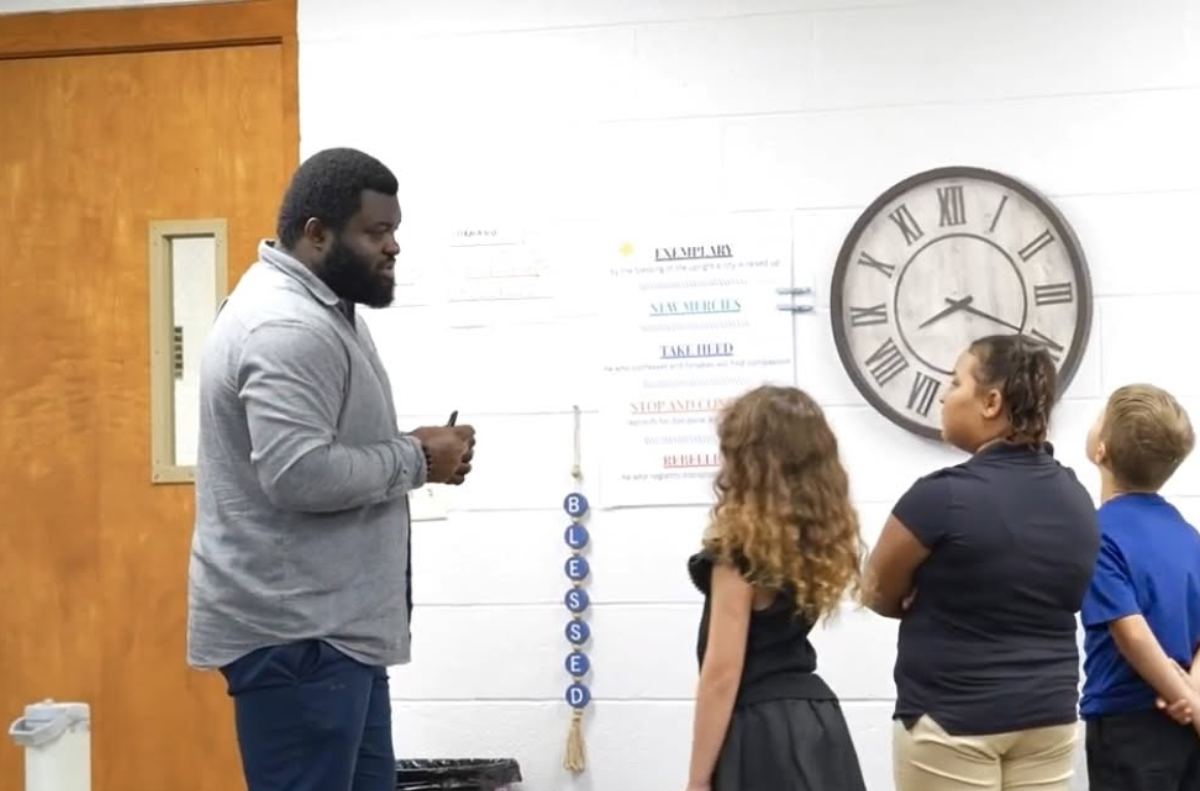

I was shocked on the first day of school last year to learn that 2/3 of my grade 3 class had less than a grade 1 level of reading proficiency. One of my students couldn’t even read the word “in.”
Our school, Berean Christian Academy, is a new classical Christian school in Marion, Ohio. Our ministry is essential in this city. This is because 45% of children in Marion are raised in single-parent homes and 30% live below the poverty line. The drug overdose mortality rate is 42 per 100,000, which is one of the highest in Ohio and almost double the national rate. The opioid crisis in Marion is one of many reasons why the county is in the top 5% across the nation for incarceration density.
In Marion County, you are 4 times more likely to meet a parent with a criminal record than a parent with a post-secondary degree.
I knew our ministry wouldn’t be easy, but I was unprepared for just how demanding it would be.
I was confused when I checked the students’ report cards and saw that their public school teachers from the preceding school year had described the students who were severely behind the grade 3 reading level as “developing.”
That is the second-highest ranking on a report card. The ranking is Masterful, Developing, Limited, Not Yet. A grade 3 student with a “developing” ranking is supposed to be mostly proficient in reading at the grade 3 level. They shouldn’t have less than grade 1 reading literacy.
According to their proficiency level, some of my students failed grade 1 and grade 2—but they were passed on to the next grade anyway. That is the norm in Marion, in Ohio, and in America.
We are raising a generation of illiterate graduates.
Marion City School District has a high school graduation rate of 84%, but its reading proficiency is 36%—a discrepancy that mirrors national averages. There is a near 50% gap between the proficiency level and the graduation rate.
On top of that, chronic absenteeism is at a record high. Chronic absenteeism measures the number of students who fall below the minimum number of hours or days required by the state. Before the pandemic, the normal rate of chronic absenteeism in America was 15%, which was already too high.
Since the pandemic, the national average has been as high as 29%. Chronic absenteeism is even higher in Marion—39%, close to double the current national rate of 23%.
America’s education system is currently in the middle of a historic crisis. Proficiency is at an all-time low, but the graduation rate is at an all-time high.
This is because public schools are incentivized to prioritize federal funding over student needs. This stems from a law, signed by Barack Obama in 2015, ironically called the Every Student Succeeds Act (ESSA), which requires every public high school to maintain at least a 67% graduation rate. To comply with the law, states must intervene and make subsequent administrative changes.
Therefore, administrators promote a “no-fail” policy that ensures high graduation rates—and administrative autonomy.
This creates a chain of pressure where the federal government pressures the state, the state pressures school districts, school districts pressure administrators, and administrators pressure teachers.
Graduation rates have sharply increased since Obama signed the Every Student Succeeds Act (ESSA), but the proficiency has stagnated or decreased.
We blame public school teachers, and they aren’t blameless. But public school teachers are more disturbed by this than the average person. The overwhelming majority of teachers (81%) believe so-called “equitable grading” or no-fail policies harm academic engagement.
To be honest, things would be much worse if it weren’t for good public school teachers who do the best they can in a difficult system. They are largely the reason why there are still some excellent students in public schools.
I know of Christian public school teachers who are doing incredible work. However, good public school teachers can change students, but they cannot change the system. That is probably why the previous teachers of my students passed them on to grade 3 instead of failing them. Since Berean Christian Academy is a private school that prioritizes Christian values and the individual academic needs of students, I expected excellence from my students.
I had the liberty to teach—I had the freedom to fail students. I refused to accept their illiteracy. I wanted to make them proficient or masterful grade 3 students and prepare them for grade 4. I gave the students who were behind more Fs than any other mark at the beginning of the year.
I developed a plan to help them read. I spent multiple hours a week, after school, strategizing on how to help these children. I spent hundreds of dollars of my own money to buy them Grade 1 and Grade 2 level reading books to help them catch up. I adapted to their level without sacrificing the curriculum.
I gave them multiple homework assignments every day to help them catch up, including regular homework, reading workbooks, and children’s books. I established order and accountability in the classroom. This prompted my students to affectionately call me “Mr. Diabolical.”
To keep them from being burdened by new expectations from our school, I created a fun environment that made them enjoy challenging work. They became so eager to improve that they did homework that I hadn’t assigned yet. One of my students was an exceptional reader. So I gave her high school (or at times, college-level) reading material to challenge her. She told me that she looked forward to that challenge every day.

Within months, the student who couldn’t read the word “in” was reading complete sentences on his own. By the end of the school year, one of the students who was at a grade 1 level became, perhaps, the best student in the grade 3 class.
The Bible says, “[We] rejoice in our sufferings, knowing that suffering produces endurance, and endurance produces character, and character produces hope.” (Romans 5:3-4)
The Apostle Paul is talking about Christian suffering, not failing students. But it is a universal truth that suffering—or failing—produces endurance, character, and hope. When we fail at something, it produces hard work and wisdom.
Children learn how to walk by learning how to fall. We learn what to do by first learning what not to do. And we learn a lot about God’s grace when we fail.
I told them that God cares much more about their hard work than their mark—and I do too. God is happier with the student who works hard but receives an F than the student who doesn’t work hard but gets an A. After all, the hard-working student will eventually succeed, and the lazy student will eventually fail.
Failing illiterate students is the best thing we can do for them. Students will not care about learning if schools do not care about teaching them. In other words, students need to fail so they can succeed.
Every teacher at the school follows a similar approach. For instance, one of our students is repeating a grade because their teacher and the headmaster knew they weren’t ready for the next grade.
We want to do what is best for the students, the parents, and the community in Marion. But we are a new and small school serving a community that has been neglected for decades. Marion is an industrial and rural area where child poverty is double the national rate at 30%.
Marion needs Christian ministries like our school, Berean Christian Academy, to serve their children. America—especially Marion, Ohio—is raising a generation of illiterate graduates, and we cannot rescue these children without your help.
Our students are receiving rigorous education and the unadulterated gospel of Jesus Christ. But like every ministry, we need financial support to continue our good work. We cannot hire more teachers and add more students without support.
Please donate to our school and support us as we serve these children.
Donate to Berean Christian Academy